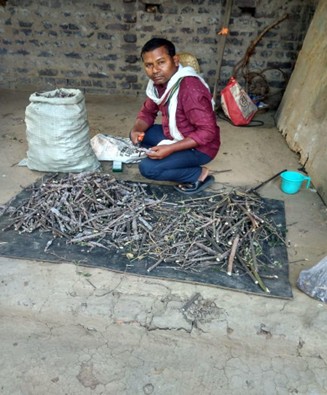
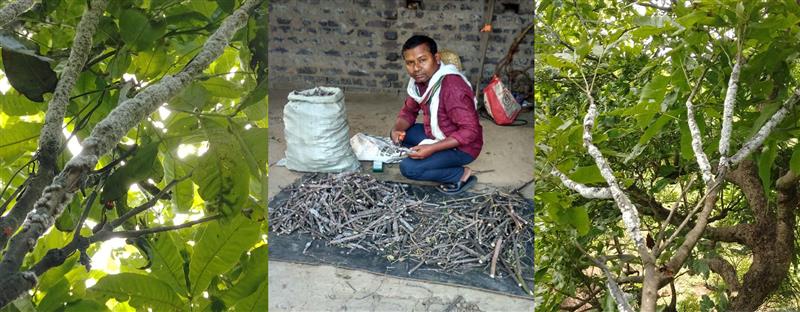
A smallholder farmer from Panchananpur village under Kandra Gram Panchayat, Jadumani lived with his wife and two children, sustaining them through rice, flax seeds, and seasonal vegetables. Though he also owned four ber trees, they stood idle, unused for any productive purpose. With limited resources and modest earnings, his livelihood left little room for growth or security.
For years, the family’s survival depended entirely on traditional farming. The income was unpredictable, and without guidance, Jadumani had no idea that his ber trees could hold the potential for something more. Lack of awareness, coupled with limited access to markets, kept him bound to the same cycle of seasonal uncertainty.
That cycle began to shift in June 2024, when the Jindal Foundation introduced a livelihood diversification program on lac cultivation, designed for small and marginal farmers with host trees. Under this initiative, Jadumani received seed lac to inoculate his ber trees, along with hands-on training in cultivation practices—covering inoculation, pest management, and harvesting techniques. Field experts visited regularly to support him, while the Foundation assured a fair buyer and price for his future harvest, shielding him from market risks.
For the first time, his ber trees became productive assets. By July 2025, Jadumani expects to harvest 7–8 kg of lac, fetching around ₹840 per kg—a meaningful addition to his household income. Encouraged by this success, he is now preparing to expand lac cultivation to kusum trees, broadening his prospects for the future.
Today, Jadumani feels more confident and hopeful.
His story shows how timely guidance and assured opportunities can turn challenges into sustainable livelihoods, helping farmers like him move from uncertainty to resilience.